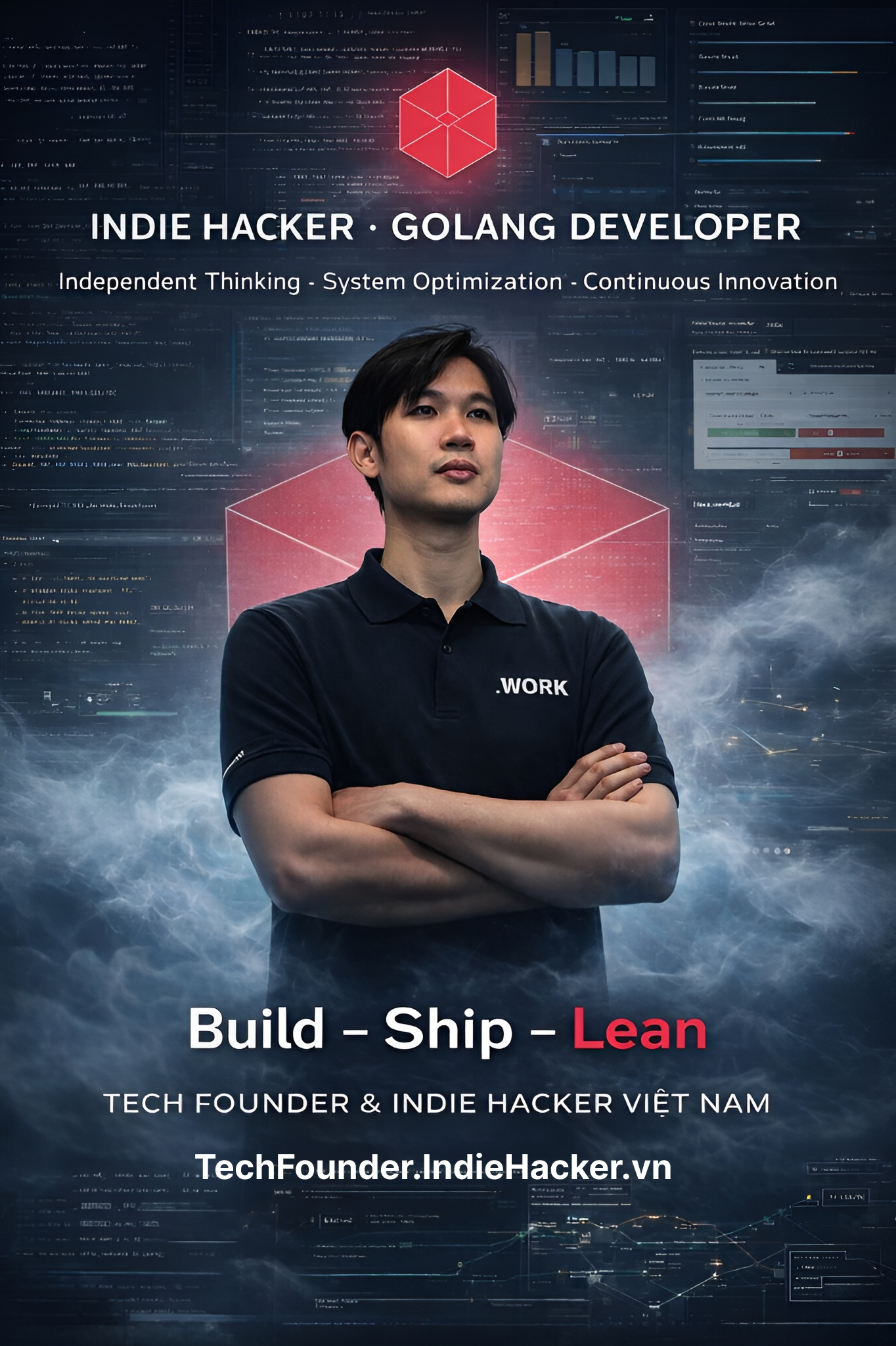
 The founder
Huỳnh Nhân Quốc
A self-taught engineer from Tam Kỳ who delivered packages by day, wrote code by night, and spent five years building the runtime that became Kitwork — alone, and on purpose.
“My path has no VC glory, no big team, no grand roadmap. Just me, an aging laptop, Go, and a dream that never sleeps.”
I don't promise to change the world overnight. I promise to build with absolute sincerity, and to never give up — no matter how rugged the road.
The dream & the collapse
A team across three countries
I didn't arrive through a computer-science degree. It began with a curiosity for Blogger around 2015, and a stretch of military service that quietly shaped how I'd write software ever after: extreme simplicity, self-reliance, and squeezing the most from limited resources.
In 2019, in Đà Nẵng, I met two people by chance who became friends — Parker from Korea and Lychee, a designer from China. Across three countries, half in broken English and half through translation apps, we built DIMODO, an app to help Vietnamese shoppers order from South Korea.
Then 2020 arrived like a storm. The pandemic scattered us — Lychee went home to Wuhan, the team dissolved, and on the eighth of January I returned to my hometown with two empty hands. The company was gone; only exhaustion and silence remained. But the dream didn't leave. It was waiting for me to be strong enough to carry it alone.
If you build your house on someone else's land, you can lose it overnight.
Starting from zero
Fifteen thousand đồng a trip
I went home to Tam Kỳ with nothing but an old laptop. By day I ran a small local delivery page — fifteen thousand đồng a trip, more than fifteen thousand orders under the heavy Central-Vietnam sun. Routing, queues and latency stopped being textbook words; I lived them on a motorbike. By night, I wrote code.
Affiliate marketing kept the lights on while I learned — the first commission was 14,000₫, about half a dollar, and it felt like proof the whole thing worked. Then I built Samdy.vn, a price-comparison engine in Go that reached Vietnam's Top 100 e-commerce sites — all of it on a single 1-core VPS beside twenty other sites.
Then Google de-indexed it and the little server buckled under its own brief success. Watching it fall is where the whole of Kitwork begins. Across five years and some eighty domains, one conviction hardened into a compass — own your code, depend on no one's platform.
Learning to control
From string to []byte, upward
For years I had used frameworks without understanding the foundations beneath them. So I started over from the ground up, writing my own template engine, my own router, my own DNS. I chose Go for three honest reasons: speed, simplicity, and control — and settled into the stack I still trust, Go, Fiber, PostgreSQL, and plain JavaScript.
I kept the web honest with Vanilla JS too. Kit JS hydrates server-rendered HTML with
no build step and no eval;
Kitwork turns whole systems into small pieces anyone can own. The principle under
all of it never changed: understand technology before you depend on it.
Bytecode is not about being low-level. It is about being done thinking.
Bytecode & energy computing
A year inside the machine
For nearly a year I lived inside compilers, runtimes and virtual machines. Bytecode stopped being a dry "intermediate representation" and became, to me, compiled thought — logic prepared so completely the machine never has to ask again, only run.
I rebuilt a Go VM down to its assumptions: I killed map[string]interface{} for O(1) static slot allocation, a
pre-allocated stack, contexts recycled through sync.Pool, and a zero-copy bridge. The result:
1,000,000 operations in 58ms, under a strict Zero-GC constraint (0 B/op).
That is what I call Energy Computing — modelling a system as E = W × T × S and spending
less by making fewer decisions, not faster ones. And once logic is bytecode, it can move:
compiled, signed, and sent like water between server, edge and client.
One runtime, many roles
A flower on the keyboard
The modern cloud drowns in Redis, Kafka, Consul and Kubernetes — brilliant alone, exhausting together. I wanted every part born from one philosophy. In Kitwork Cluster, every node runs the same runtime and simply takes a role — Gateway, Coordinator, or Worker. When one falls, another assumes its duties. The system degrades, but it does not die.
And then there's the part no benchmark measures. After the long nights inside the VM, I step away to see the sun, brew a coffee, write a quiet acoustic melody. Logic may build machines, but emotion is what builds a civilization — so I keep a flower on the keyboard to remember why any of this is worth building.
"One Runtime. Many Roles. One Source of Truth."
Five years, one compass
2015
First line of code on Blogger
Self-taught, after military service. No degree, no mentor.
2019
DIMODO — a startup across three countries
Built in Đà Nẵng with friends in Korea and China. Scattered by the pandemic.
2020
Home to Tam Kỳ, starting from zero
Delivering packages by day, rebuilding the foundations in Go by night.
2021
Samdy.vn → Top 100, then gone overnight
The lesson that became Kitwork: own the platform you run on.
2025–26
The Kitwork engine & runtime
A custom bytecode VM in Go — now in public beta, open source.
“Go outside while it is still light.”
A reminder to step away from the screen after dozens of sleepless hours and walk out to see the sun. I think of myself as a multipotentialite — a dreamy wanderer. Programming, to me, isn't dry algorithms; it's a medium for passion and real value. The calm of a system comes from the simplicity of its source.
Music by Huỳnh Nhân Quốc
Alongside the runtime, the founder writes warm acoustic and lofi music — a quiet place to balance the mind.
Listen on YouTube